Oak decline in Piedmont North Carolina is caused by chronic drought and compacted red clay soil weakening mature oaks, allowing Armillaria root rot (honey mushrooms) and Hypoxylon canker to attack. Symptoms include tip dieback (stagheading), premature leaf scorch, and peeling bark. Call Joe's Tree Care at (855) 615-0568 for diagnostic arborist evaluations and preservation pruning across Salisbury, NC.
The Oak Decline Phenomenon in the Carolina Piedmont
Throughout Salisbury, Spencer, China Grove, and Rowan County, stately willow oaks, water oaks, and northern red oaks form the majestic canopy of historic neighborhoods. However, over the past decade, property owners have witnessed an alarming trend: mature shade trees that appeared healthy for decades suddenly experience rapid canopy thinning, branch dieback, and complete structural failure.
Arborists refer to this complex condition as Oak Decline. Oak decline is not caused by a single isolated pest or disease; rather, it is a sequential, progressive syndrome triggered by predisposing site stresses, inciting climatic events, and contributing biological pathogens.
The Three-Stage Anatomy of Oak Decline
Understanding the disease spiral allows arborists and homeowners to intervene before tree mortality becomes irreversible:
- 1. Predisposing Factors (Site Stress): Old age (70+ years), shallow topsoil over dense Cecil red clay, urban soil compaction from driveways and mowers, and buried root collars from excessive mulch.
- 2. Inciting Events (Climatic Triggers): Multi-year summer droughts followed by severe spring freezes or record-setting hurricane flooding that damages fine subterranean feeder roots.
- 3. Contributing Pathogens (The Killers): Opportunistic fungi and insects that attack only when tree defenses are weakened, primarily Armillaria mellea (root rot fungus), Biscogniauxia atropunctata (Hypoxylon canker), and two-lined chestnut borers.
Diagnostic Symptom & Pathology Identification Matrix
Use this symptom guide to identify whether your oak trees in Rowan County are suffering from oak decline or fungal root rot:
| Physical Symptom | Primary Pathogen / Cause | Severity Rating | Arborist Treatment & Action Plan |
|---|---|---|---|
| Stagheading (Bare Dead Tips) | Root system can no longer pump moisture to highest crown extremities. | Moderate (Early Stage) | Crown cleaning; air-spade soil aeration; organic root biostimulants. |
| Honey Mushrooms at Trunk Base | Armillaria fungus decaying subterranean anchor and feeder roots. | Severe (Windthrow Hazard) | Assess structural root integrity with arborist sounding mallet; removal often required. |
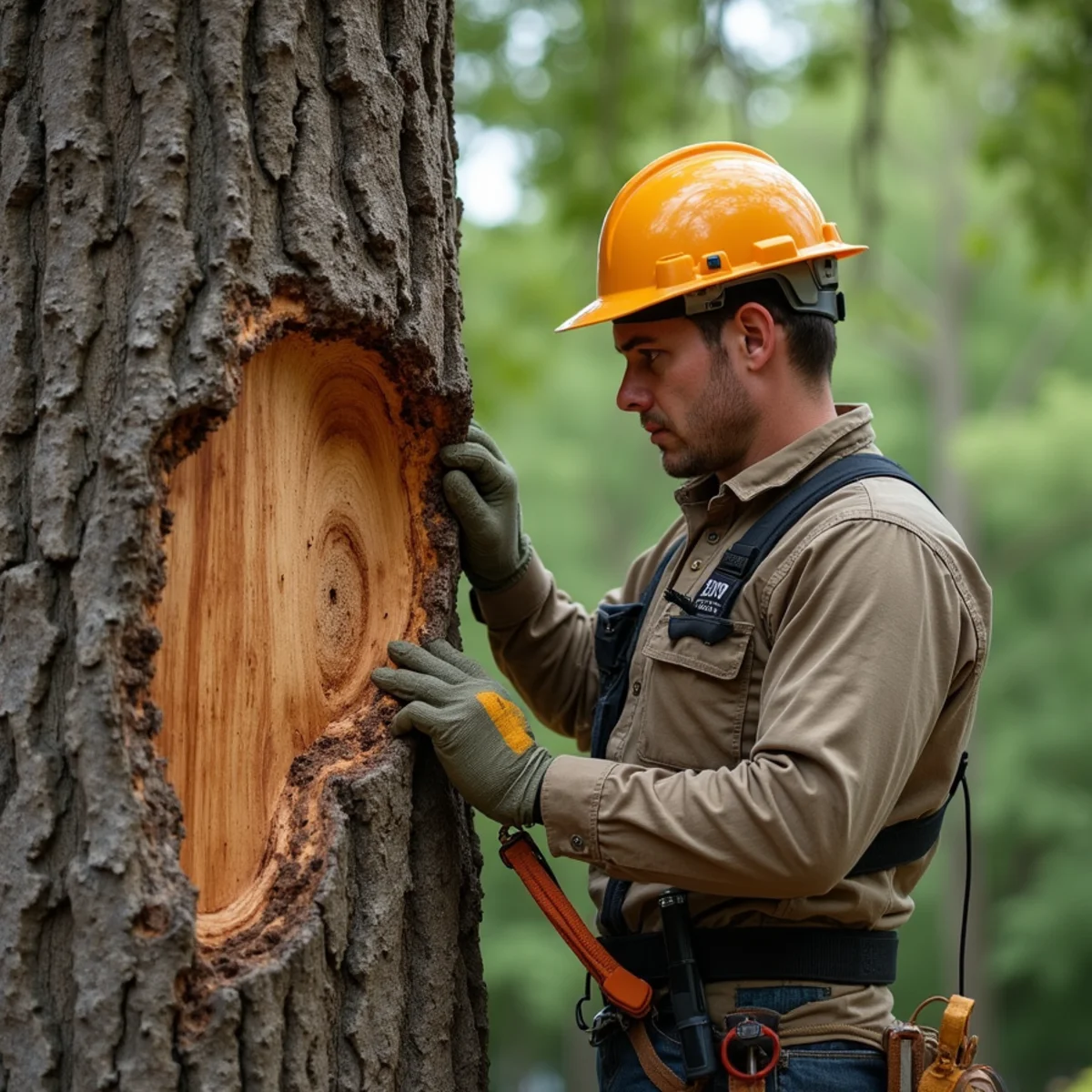
| Bark Peeling & Grey/Black Mat | Hypoxylon canker fungal stroma exposed on trunk and main limbs. | Critical / Fatal | Wood fibers rapidly lose tensile strength; schedule safe controlled removal. |
| Premature Autumn Leaf Browning | Bacterial leaf scorch (Xylella fastidiosa) or root moisture stress. | Moderate | Deep-root summer watering; therapeutic pruning of deadwood. |
The Hidden Threat of Armillaria (Shoestring Root Rot)
Among all forest pathogens in North Carolina, Armillaria root rot is the most dangerous because it attacks unseen beneath the ground. The fungus consumes the root cambium and structural buttress roots that anchor the multi-ton oak to the earth. An oak infected with Armillaria can maintain a full, green canopy of leaves while its subterranean root plate rots into soft, spongy punk.
In autumn following soaking rains, the fungus produces clusters of golden, honey-colored mushrooms around the base of the trunk. If you observe mushrooms growing directly from the root flare or trunk seams, the structural root anchors have been compromised. Under moderate storm winds, the tree can topple without warning in a catastrophic whole-tree windthrow.
Arborist Preservation vs. Safe Removal Options
At Joe's Tree Care, our certified arborists never recommend tree removal if a mature historic oak can be safely revitalized. Through our comprehensive tree health assessments in Salisbury, we evaluate internal trunk decay using sounding mallets and resistance testing.
If caught in early decline stages, we employ air-spading root collar excavation, radial soil trenching, and restorative tree trimming and pruning to restore canopy vitality. However, when Hypoxylon canker girdles the main stem or Armillaria destroys buttress roots, immediate hazardous tree removal using bucket lifts or cranes is the only responsible way to protect your home and family.
Questions & Answers About This Topic
Can an oak tree recover from Hypoxylon canker?
Unfortunately, no. Once Hypoxylon canker produces visible black or silvery-grey spore mats on the main trunk, the fungal mycelium has fully colonized the sapwood. There is no chemical cure, and the wood quickly becomes brittle and prone to sudden collapse.
How can I protect my healthy oaks during summer droughts in Salisbury?
Provide slow, deep soaking irrigation around the tree's drip line (outer edge of branch spread) once every 10 to 14 days during dry summer spells. Avoid watering directly against the trunk flare, and maintain a 2 to 3-inch layer of organic mulch keeping it 6 inches away from the bark.
Why do red oaks die faster from oak decline than white oaks?
Red oaks (including willow oaks, water oaks, and pin oaks) possess open vascular vessels that allow fungal pathogens like oak wilt and Armillaria to spread rapidly. White oaks produce tyloses—balloon-like structures that naturally plug infected vessels, giving them greater physiological resistance.
What does an arborist sounding test do?
An arborist strikes the lower trunk and root flare with a calibrated non-destructive mallet. Sound, solid hardwood produces a sharp, ringing tone, while internal decay cavities or hollow punk produce a dull, hollow thud, pinpointing hidden decay.
Joe's Tree Care Field Editorial Team
Published by owner Joe and the arboricultural team at Joe's Tree Care. Serving Salisbury, Spencer, China Grove, and Rowan County with professional tree cutting, crane takedowns, and 24/7 storm damage recovery.